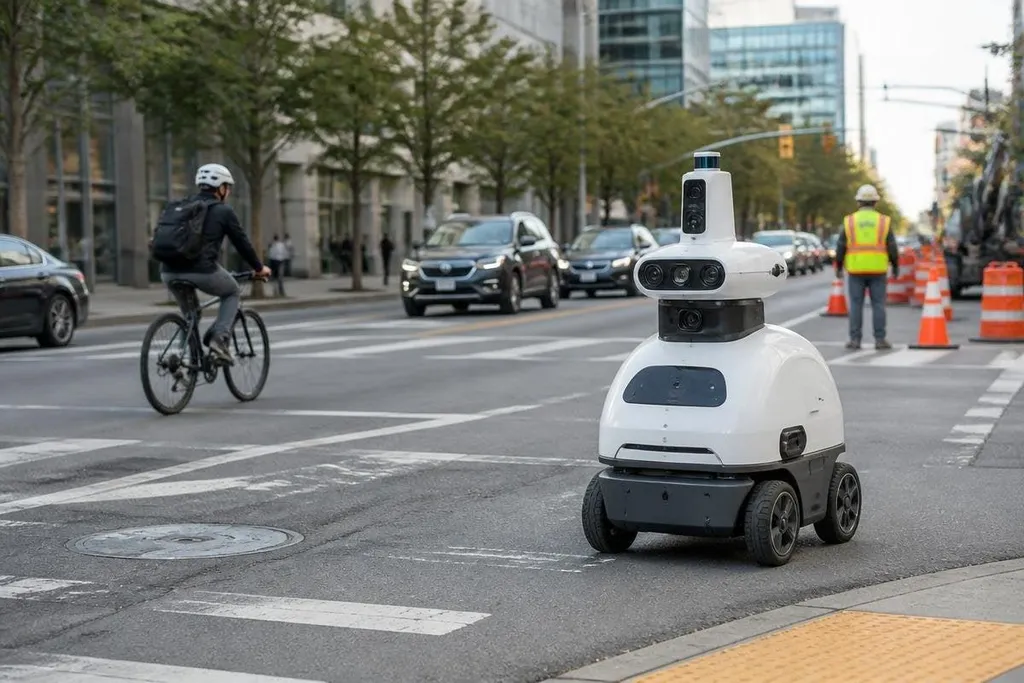
Traffic robots work near moving cars, bikes, pedestrians, and road crews. AI gives them a way to read that scene, predict what may happen next, and choose a response without a person directing every movement.
This matters most where fixed rules break down: a blocked lane, a person stepping off the curb, or a vehicle taking an unexpected path. The useful question is how much of that work AI can handle safely.
Quick read
- Cameras, LiDAR, and radar give traffic robots different views of the road.
- The system can sort road users and predict movement, but unusual events still need checks.
- Human approval remains important for actions that affect public safety.
How AI reads and predicts road scenes
A traffic robot starts with sensors. Cameras record color and shape, LiDAR measures distance with laser pulses, and radar can track movement in poor visibility. The robot combines these inputs into a working map of nearby objects.
That map turns raw sensor data into useful labels. A parked car, cyclist, road worker, traffic cone, and child each require a different response. AI vision systems can sort those objects and estimate where they may move next.
The estimate does not need to be perfect to help. If a cyclist is moving toward a robot’s path, the robot can slow down, stop, or wait for more information. It still needs a safe fallback when the sensors disagree or the scene changes too quickly.
Older traffic automation relied on fixed rules. A rule might tell a robot to stop when an object enters a marked zone. That works in a clean test area, but public roads contain gaps, blocked signs, temporary barriers, and people who do not follow the expected path.
The model can compare the current scene with patterns learned from past data. It may estimate that a vehicle will turn, that a pedestrian will cross, or that a lane will remain blocked.
The robot then ranks possible actions before it moves. This does not give the robot human judgment. It gives the control system more information before it acts, while limits still control speed, distance, braking, and access to restricted areas.
A traffic robot still has to handle a blocked lane or a signal it cannot read. Robot24.com traffic robotics coverage can show the machine, sensors, and control software behind each test before we look at the road tasks where AI can help.
Where traffic robots can use AI
Several road and transport jobs can use AI, though each carries a different safety risk. A robot can record pavement, signs, lane markings, or damaged barriers for later review. A mobile unit can inspect a blocked area while people remain outside the traffic lane.
A traffic robot can detect people waiting near a crossing and signal its status through lights or sound. Sensor systems can sort cars, bikes, buses, and pedestrians from recorded road data. A robot can also watch for movement near temporary barriers and alert a control room.
The sensing task may be easier than the action that follows. Recording a damaged sign carries less risk than directing vehicles around a lane closure, so the second job needs tighter rules and human review.
The limits are in the unusual cases
AI learns from examples, yet road events often combine details that were missing from its training data. A fallen load, a person waving from a stopped vehicle, heavy rain, glare, or a temporary sign can confuse the system.
Sensors also have physical limits. Cameras can lose detail in darkness or glare. LiDAR can return poor data from some surfaces. Network delays can leave a remote operator viewing an older scene than the robot is handling.
I’d trust a traffic robot first with inspection and alerts, then consider movement near people after long, public tests. That order puts the lower-risk work ahead of decisions that can injure someone.
A practical check before deployment
Use this list before placing an AI traffic robot near public movement:
- Name the task: Record the exact action the robot may take and the actions it must never take.
- Set the fallback: Define what happens after lost data, sensor conflict, or a failed network connection.
- Test unusual scenes: Include glare, rain, blocked signs, stopped vehicles, and people outside marked paths.
- Keep a human link: Give an operator a clear view, an emergency stop, and authority to pause the robot.
- Log each event: Store sensor data, warnings, stops, and operator actions for later review.
- Set a review date: Recheck the system after road layouts, signs, or traffic rules change.
These models can make traffic robots better at reading messy scenes, but reading is only one part of safe operation. The next measure that matters is how often these systems stop correctly when the road gives them something their training did not contain.